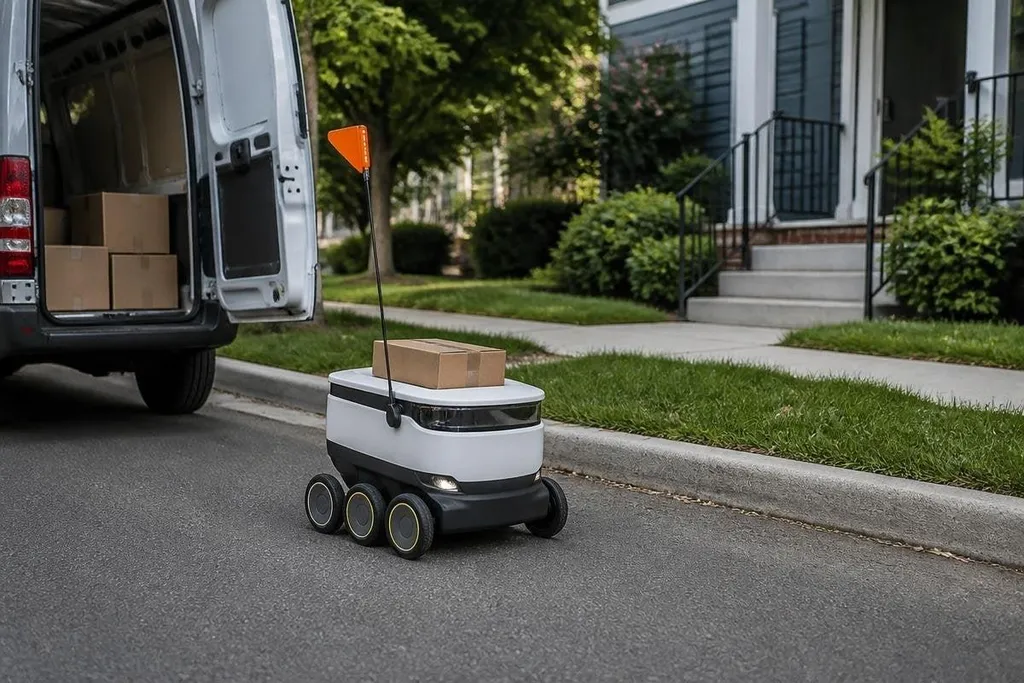
A last-mile robot carries a parcel between a local depot and a nearby home, office, or collection point. The trip can take less time when the robot moves while a driver handles longer routes, but streets, doors, and weather still decide where the plan works.
Quick read
- Robots can handle short trips from a local depot.
- One operator may watch several robots, depending on the system and local rules.
- Locked doors, busy crossings, and poor sidewalks can erase the time saved.
Where the time comes from
A delivery van loses time each time it parks, reaches a door, and returns to the road. A small robot can leave a depot, travel along a sidewalk, and wait at the delivery point without sending a driver out for every parcel.
That changes the route plan. A driver can carry parcels to a set area, while robots cover nearby addresses in smaller loops. The driver still handles roads and buildings that robots can't reach, so the robot adds another way to move parcels rather than replacing every van trip.
Short runs suit a robot because a van may spend more time stopping than driving. A long route between scattered homes gives the robot less to gain, since it must return to a depot or another handoff point after each run.
How a delivery robot works
The robot uses cameras, other sensors, and software to keep track of its position. It must detect people, bikes, curbs, parked cars, and objects blocking the sidewalk, then choose a safe path around them.
At the destination, the parcel stays inside a locked compartment. The customer may receive an access code through an app or another delivery system. That step removes one common delay: a driver waiting while someone comes to the door.
A remote operator may help when the robot reaches a case its software can't handle. The operator doesn't need to guide every metre, but they may review a blocked route or confirm that the robot can continue.
The number of robots one operator can watch depends on the robot's software, the route, and the number of problems on that route.
The places where it works
Last-mile robots need a route that supports steady movement. Wide sidewalks, clear crossings, nearby homes, and a depot within the service area all help. A university campus, business park, or planned housing area may offer these conditions more often than a dense city street.
Local rules matter too. A robot may need permission to use public sidewalks, and the operator may need to meet safety requirements. A route can work in one town and fail in another because the curb layout, crossing rules, or delivery access differs.
A delivery robot’s speed means little without the town, route, test date, and rule set behind it. A reader comparing trials can use Robot 24 to check those facts beside the reported result, then judge whether the route survives the final handoff.
The limits that slow the handoff
Reaching the building doesn't mean the delivery is complete. The robot may face stairs, a locked entrance, a lift, a narrow path, or a customer who isn't ready to collect the parcel. Each extra handoff adds time and creates another point of failure.
Weather can affect sensors and grip. Heavy rain, snow, ice, and fallen leaves may make the route harder to read or less safe to cross. The robot also needs enough battery for the trip, the return, and the pauses caused by people or blocked paths.
Privacy and safety need clear answers before a service grows. Cameras may record the route, while the robot shares space with people who didn't ask to appear in its data. Operators need rules for storage, access, emergency stops, and contact with pedestrians.
A practical test for a delivery route
Before adding robots to a delivery plan, check these points:
- Depot distance: Can the robot reach the service area and return without a battery stop?
- Path quality: Do sidewalks and crossings give it a clear, repeatable route?
- Building access: Can customers collect parcels without stairs, staff help, or a second handoff?
- Operator work: Who handles blocked paths, damaged parcels, and urgent stops?
- Local permission: Does the route meet the town's rules for sidewalk robots and recorded video?
- Customer fit: Will people accept a locked compartment and app-based collection?
I'd use a last-mile robot first on a short, repeatable route with easy building access. That gives the operator a clear way to measure delivery time, failed handoffs, battery use, and customer response before adding harder streets.
The next proof is simple: run the same route with and without the robot, then count the full trip from depot departure to parcel collection.